Gradients
Linear, radial, and repeating gradients all round-trip natively.
CSS gradients convert to native SVG <linearGradient> and
<radialGradient> elements. Stop colors, positions, and
angles are emitted in pixels — there's no floating-point approximation in
the output, and the gradient stays correct under any zoom level because
the SVG viewBox handles proportional scaling.
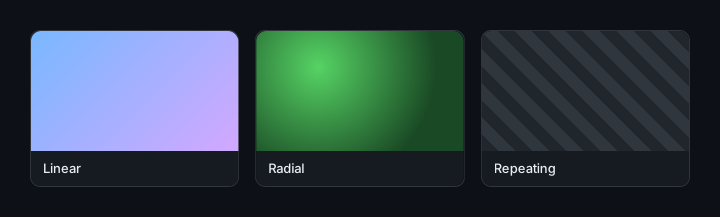
What works without caveats: angle-based and keyword-based linear gradients
(linear-gradient(135deg, ...), linear-gradient(to right top, ...));
radial gradients with circle and ellipse shapes, sizing keywords
(closest-side / closest-corner / farthest-side
/ farthest-corner), and offset centres (at <position>);
both repeating-* variants (spreadMethod="repeat");
hint stops and double-position stops; gradients applied via
background-clip: text.
The exceptions
conic-gradient— no SVG equivalent in<img>-rendered SVG. The layer is skipped and a warning is logged.- Non-sRGB interpolation. CSS Color Module 5 lets you
pick alternate interpolation spaces
(
linear-gradient(in oklch, ...)); Domotion samples the resolved gradient at fixed positions and emits sRGB stops. The output is visually close but not identical for OKLCH-interpolated gradients with widely-separated colors.
Examples
Each of these captures cleanly:
/* Diagonal accent */
background: linear-gradient(135deg, #79b8ff 0%, #d2a8ff 100%);

/* Gradient text */
background: linear-gradient(90deg, #79b8ff, #56d364);
-webkit-background-clip: text;
color: transparent;

/* Glow */
background: radial-gradient(circle at center, #79b8ff 0%, transparent 70%);

/* Stripes */
background: repeating-linear-gradient(45deg, #1a2029 0px 10px, #21262d 10px 20px);